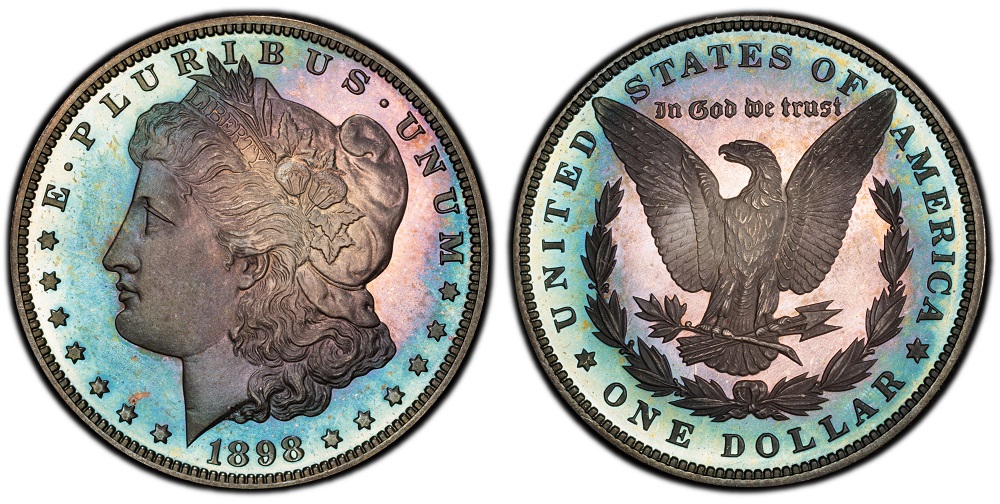
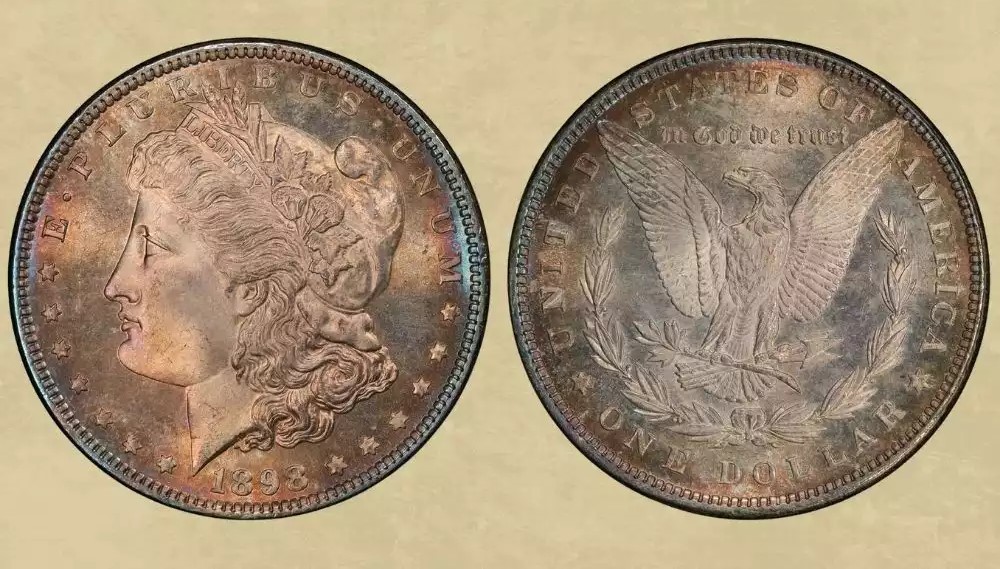
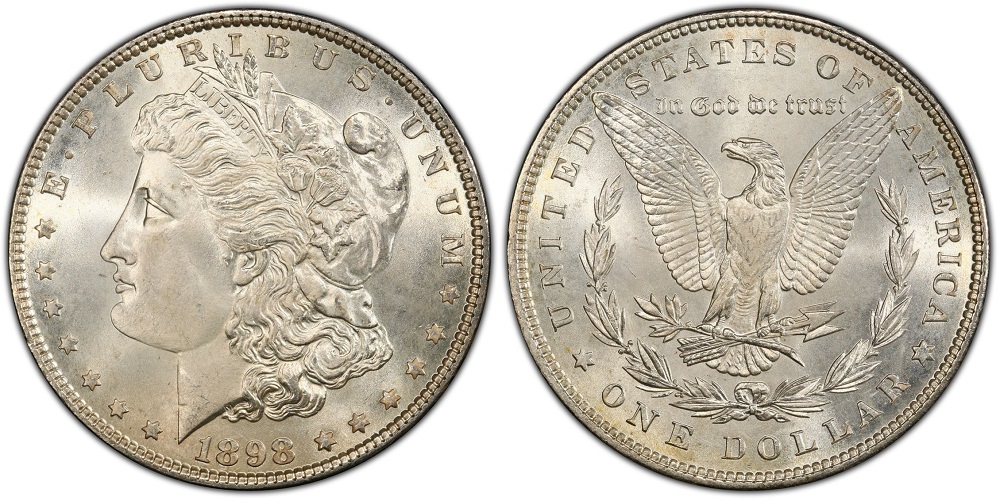
1898 Morgan Silver Dollar obverse and reverse — Philadelphia issue showing Liberty portrait and eagle design

The 1898 Silver Dollar Value Guide

An 1898-S Morgan dollar in MS-68 sold for $117,500 at auction — yet the same coin in worn condition is worth under $100. Your coin's mint mark, grade, and surface finish determine everything. Use the free calculator below to find out where yours falls on that spectrum, from face-value to five figures.

⭐⭐⭐⭐⭐ Rated 4.8/5 by 1,473 collectors · Free · No account needed

Check My 1898 Silver Dollar Value →
$117,500
Top auction record (1898-S MS-68)
14.4M+
Business strikes across 3 mints
735
Proof specimens struck in 1898
90%
Silver content by weight

1898 Silver Dollar Value Chart at a Glance

Before pulling up the calculator, a quick scan of this table tells you roughly where your coin stands. For a deeper look at every grade tier — including how strike quality and die state affect the Philadelphia issue — this complete 1898 silver dollar identification and value breakdown covers every variety in detail. The 1898-S row is highlighted in gold because it carries the highest upside at elevated grades; the Proof row is highlighted in orange because of its extreme rarity.

Variety Worn (G–VG) Circulated (F–AU) Uncirculated (MS-60–63) Gem (MS-64–66+)
1898-P (No Mint Mark) ~$84 $84 – $86 $87 – $155 $160 – $3,030+
1898-P DMPL $11 – $12 $21 – $120 $160 – $500 $1,000 – $35,400+
1898-O (New Orleans) ~$84 $84 – $86 $82 – $200 $250 – $25,300+
1898-O DMPL $34 – $40 $65 – $390 $500 – $2,500 $5,000 – $52,900+
⭐ 1898-S (San Francisco) ~$84 $84 – $360 $460 – $1,200 $2,500 – $138,000+
🔴 1898 Proof (Philadelphia) $2,020 – $101,200+

📱 CoinHix is a fast on-the-go way to estimate your 1898 Morgan dollar's value by snapping a photo and comparing it to graded examples — a coin identifier and value app.

Quick Navigation

The Valuable 1898 Silver Dollar Errors & Varieties (Complete Guide)

While no single confirmed major hub-doubled die variety has been exclusively attributed to the 1898 Morgan dollar series, several types of mint-related errors and surface designations dramatically affect value. The varieties below — from DMPL surface designations to repunched mint marks, doubled dies, and mechanical errors — are the ones collectors actively seek and pay premiums for. Understanding which applies to your coin is the first step to unlocking its true value.
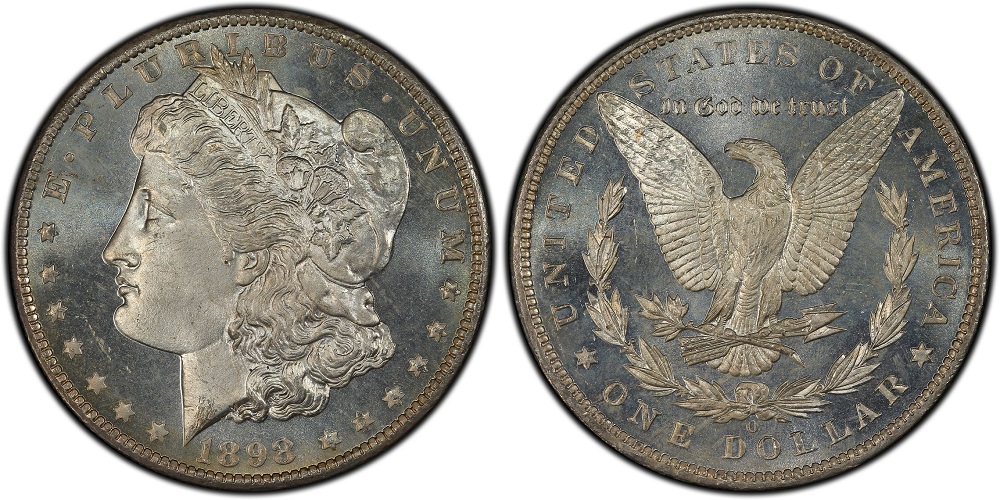
1898 Morgan dollar Deep Mirror Proof-Like (DMPL) obverse showing highly reflective fields and frosted Liberty design

Deep Mirror Proof-Like (DMPL) Surface Designation

MOST VALUABLE $160 – $52,900+

DMPL coins are business-strike Morgan dollars produced from heavily polished working dies early in a die's production run. When freshly polished dies strike a planchet, the result is mirror-like fields similar to proof coins, paired with frosted, satiny devices — a dramatic cameo contrast that commands the series' largest premiums over standard business strikes.

To identify a DMPL, hold the coin at a 45-degree angle under a single incandescent light source. Your reflection should be clearly visible in the flat fields surrounding Liberty's portrait. PCGS requires a minimum of six inches of reflectivity to award the DMPL designation; standard Proof-Like (PL) coins show some reflection but are less dramatic. True DMPLs are noticeably more intense than PLs even under casual inspection.

The 1898 Philadelphia DMPL is approximately twice as scarce as a standard PL, according to population data Wayne Miller first documented in 1982 and PCGS grading data has since confirmed. The 1898-O DMPL in gem grades has reached $52,900, making it one of the most valuable business-strike 1898 Morgan dollars outside the 1898-S. Collectors prize these coins because the proof-like finish ages distinctly, and original untoned examples are especially desirable.
How to spot it Look for a sharply reflected image of your face in the flat fields when you tilt the coin under a single light; frosted Liberty devices provide strong contrast. A 5× glass confirms the field quality clearly distinguishes DMPL from standard MS.
Mint mark All three mints (P, O, S); the 1898-O DMPL commands the highest premiums in gem grades.
Notable PCGS population data shows the 1898-O DMPL is rarest in the series in high grade; an MS-65 DMPL example has sold at Heritage for over $10,000. PCGS requires 6-inch minimum reflectivity for the DMPL designation.
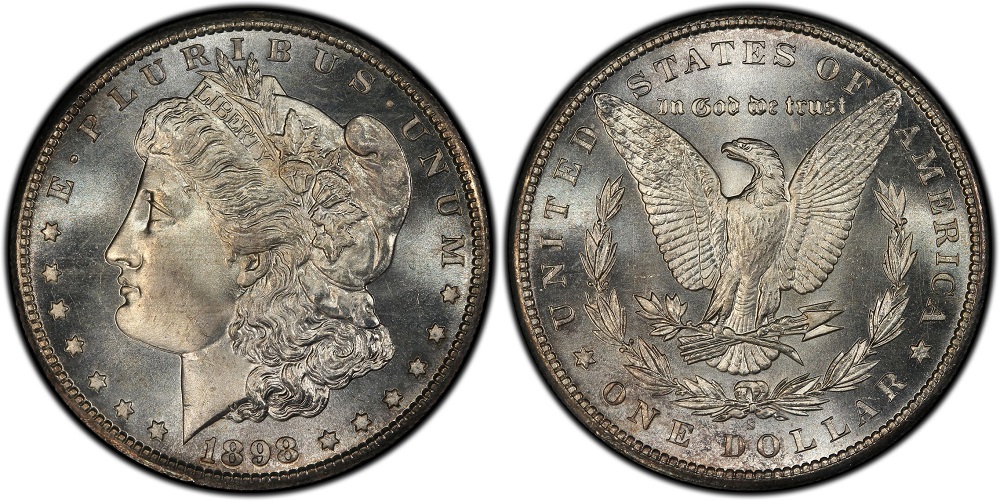
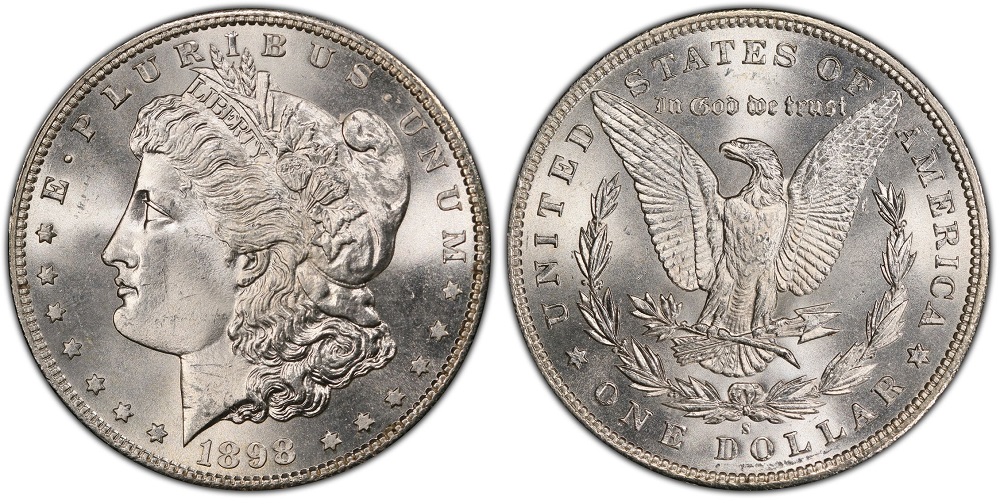
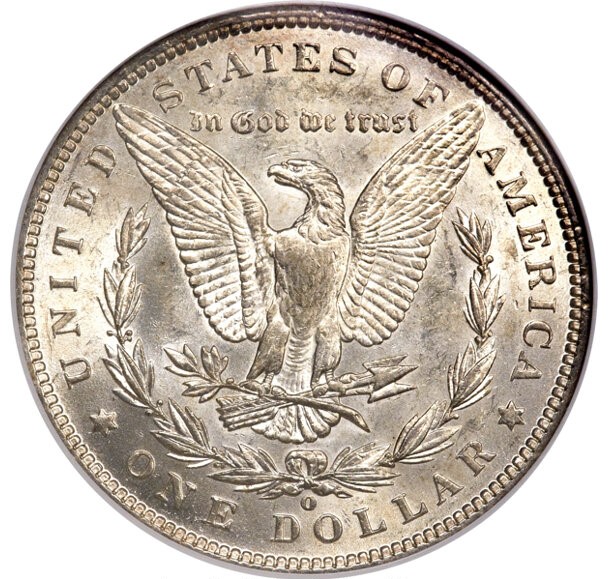
1898-S Morgan Silver Dollar reverse showing S mint mark above DOLLAR lettering with sharp eagle breast feather detail

1898-S — San Francisco Issue

MOST FAMOUS $84 – $138,000+

The 1898-S is the key date among 1898 Morgan dollar business strikes and the reason collectors search the date so eagerly. With a mintage of 4,102,000 — the lowest of the three 1898 mints — the San Francisco issue is not particularly scarce in lower grades, but it escalates in value far more steeply than Philadelphia or New Orleans as condition improves.

The S mint mark is located on the reverse, above the ribbon bow and below the eagle's tail feathers, between the letters D and O in DOLLAR. San Francisco coins from this era are generally well struck, with sharp feather detail on the eagle's breast and well-defined hair curls above Liberty's ear. Collectors specifically seek examples with minimal bag marks on Liberty's cheek and no heavy contact marks in the obverse fields.

The all-time auction record for any 1898 Morgan dollar belongs to an 1898-S graded MS-68, which sold for $117,500. At the MS-65 gem level the coin is already substantially scarcer than its Philadelphia counterpart, and MS-67+ examples are genuinely rare. The PCGS population report shows very few pieces certified above MS-66, making high-grade 1898-S dollars among the more competitive targets in the Morgan dollar series.
How to spot it Locate the S mint mark on the reverse between the eagle's tail feathers and the bow, above the DO in DOLLAR. Confirm under a 5× loupe; the S is distinctive versus the O and the absence of a mark indicates Philadelphia.
Mint mark S (San Francisco only); mintage 4,102,000 business strikes.
Notable $117,500 auction record (MS-68, Heritage Auctions). PCGS population shows very few coins above MS-65, making gem survivors genuinely scarce relative to demand from Morgan dollar specialists.
1898-O Morgan dollar reverse close-up showing repunched mint mark with secondary O impression visible under magnification

Repunched Mint Mark (RPM)

BEST KEPT SECRET $90 – $500+

A repunched mint mark occurs when a die technician struck the mint mark punch into a working die more than once, with the second strike landing in a slightly different position. The result is a doubled image of the mint mark visible under magnification — a clear secondary impression alongside or partially overlapping the primary letter. The 1898-O and 1898-S dollars are the candidates to examine, since Philadelphia coins carry no mint mark at all.

To identify an RPM, examine the mint mark closely under a 10× loupe. Look for a secondary serif, a ghost impression of the letter, or a doubled north or south edge of the O or S. The doubling should be consistent in direction across the entire letter — not just a random surface mark. PCGS and NGC both attribute confirmed RPM examples within the VAM cataloging system established by Van Allen and Mallis.

Confirmed RPM varieties on 1898 Morgan dollars carry modest premiums over non-variety examples in the same grade, typically adding 10%–50% in circulated grades and more in Mint State depending on the drama of the doubling. While not the showstopper of a DMPL or an 1898-S gem, a clearly attributable RPM represents an accessible variety that beginning Morgan dollar specialists enjoy pursuing. Always pair with a VAM reference for formal attribution.
How to spot it Under a 10× loupe, look for a secondary impression of the O or S mint mark — a slight ghost or doubled edge in a consistent direction across the entire letter. Flat machine doubling has no premium; only true hub or punch doubling counts.
Mint mark O (New Orleans) and S (San Francisco) issues only; the Philadelphia (no mint mark) coin cannot show this error.
Notable Cataloged within the Van Allen–Mallis (VAM) attribution system; confirmed RPM examples are listed in the PCGS CoinFacts VAM index for the 1898-O and 1898-S. Premiums vary widely by the visibility and drama of the doubling.
1898 Morgan dollar obverse showing doubled die characteristics on the date and legend lettering under magnification

Doubled Die Obverse / Reverse

RAREST FIND $100 – $800+

A doubled die error occurs when a working die receives a second, slightly misaligned impression from the master hub during the hubbing process. The result is a coin showing a shadow or "shelf" image alongside the primary design elements — doubling visible on the date digits, the legends, Liberty's features, or the eagle on the reverse. Genuine hub doubled dies show consistent, three-dimensional doubling that differs clearly from common mechanical (machine) doubling, which appears as flat, smeared surfaces with no collector premium.

On 1898 Morgan dollars, examination should focus on the date digits (look for a separated shelf below or beside each numeral), the letters of IN GOD WE TRUST on the obverse, and E PLURIBUS UNUM on the reverse. Liberty's eye and eyelid are also classic locations for hub doubling on Morgan dollars. Always confirm using a 10× loupe — if the doubling shows depth and separation, it may be genuine; if it appears flat and smeared, it is likely mechanical doubling without numismatic value.

Genuine doubled die 1898 Morgan dollars are not formally designated as a major variety in the PCGS CoinFacts primary listing, but individual VAM attributions may encompass minor hub-doubling elements. Confirmed doubled dies add 25%–100% premiums over type coins in comparable grades, with the premium increasing significantly at higher Mint State levels where the doubling is sharp and undisturbed. Professional attribution from PCGS or NGC is essential before claiming a premium.
How to spot it Under a 10× loupe, look for separated, three-dimensional doubling on the date digits, legends, or Liberty's eye — doubling that appears raised, not flat or smeared. Machine doubling (no premium) looks like a slid smear; hub doubling shows distinct separation.
Mint mark Potentially all three mints (P, O, S); no single confirmed dominant date-specific doubled die is attributed to 1898 as a major variety.
Notable Any confirmed doubled die on an 1898 Morgan dollar should be submitted for VAM attribution through PCGS or NGC. The 1901 Morgan Doubled Die Reverse (a related series coin) demonstrates how dramatically hub doubling can drive values — establishing the reference point for this error type in the Morgan series.
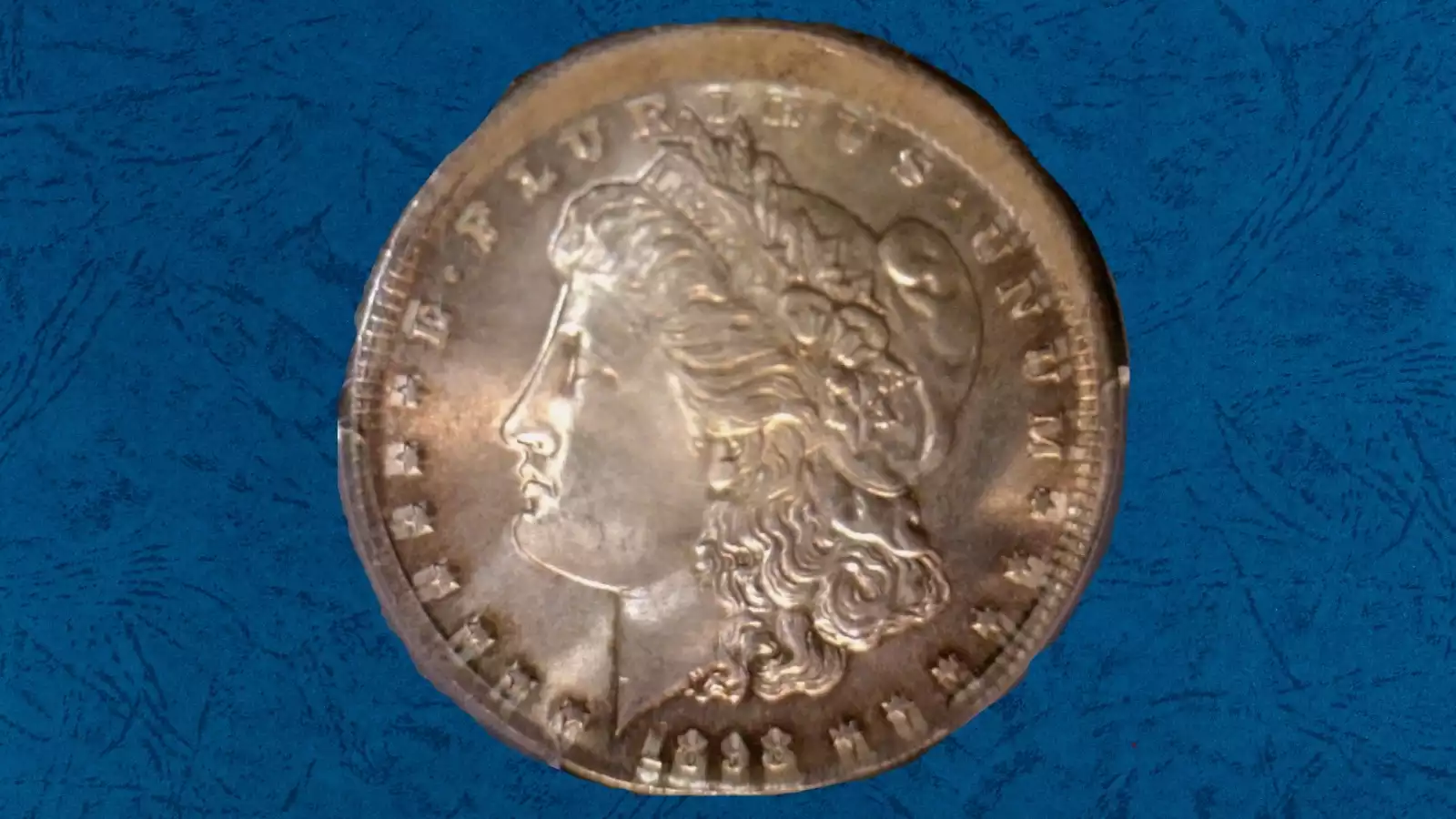
1898 Morgan dollar broadstrike or off-center strike error showing expanded planchet and weak or absent collar rim

Broadstrike & Off-Center Strikes

RAREST ERROR $200 – $1,500+

Broadstrike errors occur when the collar die — which normally constrains the planchet to produce a round coin with a reeded edge — fails during the strike. Without collar containment, the silver spreads outward, producing a coin that is noticeably wider and thinner than normal, with a flat, undefined rim instead of the typical raised beaded edge. Off-center strikes result when the planchet shifts between the dies at the moment of striking, producing a coin where part of the design is missing and a blank arc of silver is visible.

On a Morgan dollar broadstrike, the coin will be measurably wider than the standard 38.1 mm diameter — sometimes reaching 40 mm or more — and the reeded edge will be absent, replaced by a rough, spreading rim. Off-center strikes on large silver dollars are visually dramatic: a 20% off-center coin will show the entire date and a large arc of blank planchet. Coins with a full, readable date on off-center strikes are significantly more desirable than those where the date has been partially lost in the blank area.

Both broadstrikes and off-center errors are genuinely uncommon on Morgan dollar-era silver dollars because the Mint applied stricter quality control to high-denomination coinage. When found, they attract strong interest from error coin specialists. An off-center 1898 Morgan dollar with full date, in the 10%–20% off-center range, can sell for several hundred dollars in circulated condition and well over $1,000 in Mint State, depending on the degree of offset and overall eye appeal.
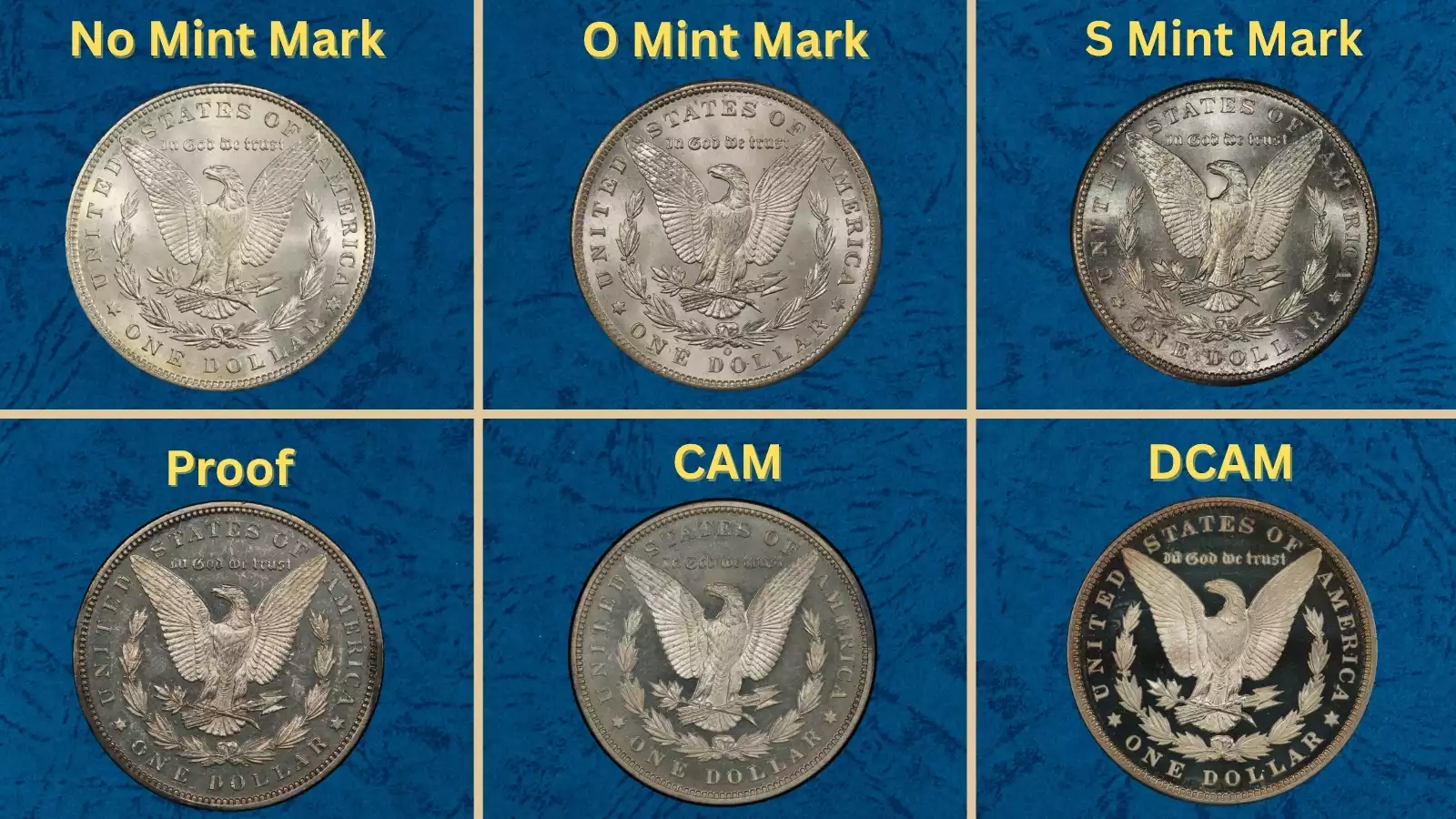
How to spot it Measure the coin's diameter — a broadstrike will be noticeably wider than 38.1 mm with a plain (non-reeded) edge. For off-center strikes, look for a blank arc of planchet visible at the edge with the design shifted to one side. Date must still be readable for maximum premium.
Mint mark Potentially any mint (P, O, S); these are planchet/die mechanical errors, not mint-specific design varieties.
Notable Off-center Morgan dollars at 10%–25% off-center with full date command the strongest premiums. Broadstrike Morgans are especially uncommon because the higher-denomination production received more quality oversight than cent or nickel production in the same era.

Think you've spotted one of these varieties on your coin?

Run the Value Calculator →

1898 Morgan Dollar Mintage & Survival Data

Collection of 1898 Morgan Silver Dollars from Philadelphia, New Orleans, and San Francisco mints showing all three mint mark varieties
Mint Mint Mark Business Strike Mintage Proof Mintage Est. Survivors (All Grades)
Philadelphia None 5,884,000 735 ~588,000
New Orleans O 4,440,000 ~444,000
San Francisco S 4,102,000 ~410,000
Total 14,426,000 735 ~1,442,000
Composition specs: 90% silver / 10% copper · Weight: 26.73 g · Diameter: 38.10 mm · Designer: George T. Morgan · Edge: Reeded. The silver melt value of a single 1898 Morgan dollar is approximately 0.7734 troy oz of pure silver — making even heavily worn examples worth a meaningful bullion floor regardless of numismatic grade.

Survival rates shown are estimates based on PCGS population data and published survival studies. Philadelphia coins were widely released through Federal Reserve banks in the 1950s–1960s, explaining the large proportion of surviving Mint State examples relative to the New Orleans and San Francisco issues.

How to Grade Your 1898 Morgan Dollar

1898 Morgan dollar grading strip showing four condition tiers from worn to gem Mint State side by side
Tier 1

Worn (G–VG)

Heavy wear has flattened Liberty's hair curls and cheek. The date and LIBERTY headband lettering remain readable. All major design elements visible but without fine detail. Most details on eagle's breast merged flat. Value: ~$84 for all three mints.

Tier 2

Circulated (F–AU)

The fine hair strands above Liberty's ear are partially visible. Some mint luster survives in protected areas on AU examples. Eagle's breast feathers show some definition. The slightest rub on the cheek or eagle's breast drops an AU coin to high-end circulated. Value: $84–$360 depending on mint mark.

Tier 3

Uncirculated (MS-60–63)

Full original luster with no wear. Bag marks from storage in canvas bags are expected and acceptable at MS-60–62. Liberty's cheek shows no trace of rub. Eagle's breast feathers are sharp and distinct. MS-63 examples should have no individually distracting marks on the cheek or major fields.

Tier 4

Gem (MS-64–67+)

MS-64 shows only minor scattered marks. MS-65 requires a clean cheek and nearly mark-free fields. At MS-66 and above, only a handful of minor contact marks are tolerated in non-focal areas. MS-67+ examples are exceptional — genuinely scarce for all three 1898 mints and extremely valuable for the 1898-S.

Pro tip — Prooflike designation: Even in circulated grades, mirror-like fields on an 1898 Morgan can earn a PL or DMPL designation when submitted to PCGS or NGC. Always check the fields with a good light before assuming your coin is a standard business strike — the PL or DMPL designation can multiply its value several times over without changing a single numeral in the grade.

🔎 CoinHix lets you match your coin's surface condition against reference images of graded examples for a quick at-home assessment — a coin identifier and value app.

1898-S Morgan Dollar Self-Checker

The 1898-S is the most valuable business-strike 1898 Morgan dollar — but it's only valuable if yours is genuine and not just a Philadelphia coin with a damaged mint mark area. Use this checklist to assess whether your coin is the real San Francisco issue.

Side-by-side comparison of 1898 Philadelphia (no mint mark) and 1898-S Morgan dollar reverses, with S mint mark highlighted

🔵 Common: 1898 Philadelphia (No Mint Mark)

No letter above the ribbon bow on the reverse. Struck at Philadelphia. Very common in all grades. Worth $84–$3,030 depending on condition and surface designation. DMPL examples are the most desirable Philadelphia 1898s.

— vs —

⭐ Rare: 1898-S (San Francisco)

A clear "S" appears above the ribbon bow on the reverse. San Francisco issue. Significantly more valuable in all Mint State grades. Auction record: $117,500 (MS-68). Even circulated examples above AU command premiums over Philadelphia pieces.

Check all four that apply to your coin:

Got a result? Now check exactly what your 1898-S — or any 1898 Morgan — is worth in today's market.

Use the Value Calculator →

Free 1898 Silver Dollar Value Calculator

Select your coin's mint mark, grade, and any known varieties below for an instant value estimate based on published auction data.

Step 1 — Select Mint Mark
Step 2 — Select Condition
Step 3 — Known Varieties / Surface (optional)

If you're not yet sure about your coin's mint mark, grade, or surface — there's a free 1898 Silver Dollar Coin Value Checker with photo upload where you can snap a photo and get a guided estimate without needing to know the details in advance.

Describe Your 1898 Morgan Dollar for a Detailed Assessment

Not sure how to classify your coin? Describe what you see in the box below and get a personalized assessment in seconds.

Mention these things if you can

  • Any letter (O or S) on the reverse, or no letter
  • Is there any wear on the hair above the ear?
  • Do the fields look mirror-like when you tilt it?
  • How many visible bag marks or contact marks?

Also helpful

  • Color (bright silver, toned, dark patina)
  • Any unusual lines, doubling, or doubled letters
  • Does the edge have reeding (ridges) or is it plain?
  • Has the coin been cleaned or polished?

Where to Sell Your Valuable 1898 Morgan Dollar

The right venue depends on the grade and rarity of your coin. A common circulated 1898-P is easy to sell anywhere; a gem 1898-S DMPL deserves a full auction house campaign.

🏛️ Heritage Auctions

The best venue for high-grade examples (MS-65+) and proof coins. Heritage reaches the largest pool of serious Morgan dollar specialists and consistently delivers record prices for gem and PL/DMPL examples. Submit at least 6 weeks before your target auction. Minimum consignment values apply.

🛒 eBay

Ideal for circulated and lower Mint State examples. Check recently sold 1898 Morgan dollar prices and completed listings to set a realistic reserve. Third-party grading (PCGS or NGC) significantly boosts buyer confidence and final prices even on eBay.

🏪 Local Coin Shop

Fast, hassle-free sale with immediate payment. Best for common circulated 1898-P or 1898-O examples where the dealer margin won't cost you much. Bring multiple offers — dealers typically pay 60%–80% of retail for common dates, less for key dates they already have in inventory.

💬 Reddit r/Coins4Sale

Good community for mid-grade coins (MS-62 to MS-64). Pricing is often closer to retail than a local dealer, but transactions take more effort and trust-building. Helpful for collectors who already have a strong Reddit account history and positive feedback from prior transactions.

💡 Get it graded first: Any 1898 Morgan you believe is MS-64 or better, a DMPL, or a proof should be submitted to PCGS or NGC before selling. Professional grading adds authenticity, increases buyer confidence, and typically more than pays for itself in higher final prices — particularly for 1898-S examples above MS-64 where even a one-point grade difference represents hundreds or thousands of dollars.

Frequently Asked Questions — 1898 Silver Dollar Value

How much is an 1898 silver dollar worth?

An 1898 Morgan silver dollar is worth roughly $84 in worn Good condition, $86 in About Uncirculated, and $87 to over $3,000 in Mint State for the Philadelphia issue. The 1898-S in Mint State ranges from about $460 to over $117,000 for a gem MS-68. Your specific value depends on mint mark, grade, and surface designation (PL or DMPL).

What is the most valuable 1898 Morgan dollar?

The most valuable 1898 Morgan dollar ever sold is an 1898-S graded MS-68, which realized $117,500 at auction. The 1898 Philadelphia in MS-68 has sold for $64,625, and the 1898-O MS-68 achieved $49,938. Proof examples with Deep Cameo designation have reached over $64,000. High grade and eye appeal are the primary drivers of top-end value.

What mint marks were used on 1898 Morgan dollars?

Three mints produced Morgan dollars in 1898: Philadelphia (no mint mark, 5,884,000 coins), New Orleans (O mint mark, 4,440,000 coins), and San Francisco (S mint mark, 4,102,000 coins). Additionally, Philadelphia struck 735 proof coins for collectors. The mint mark, if present, appears on the reverse above the DO in DOLLAR.

Is the 1898-S Morgan dollar rare?

The 1898-S is the scarcest of the three business-strike varieties, with a mintage of 4,102,000. While not rare in lower circulated grades, it becomes significantly scarcer above MS-64. High-grade gems (MS-66 and above) are genuinely difficult to find. The 1898-S climbs in value much faster than the Philadelphia or New Orleans issues as grade increases.

What are DMPL coins and are they valuable?

DMPL stands for Deep Mirror Proof-Like. These are business-strike coins struck from freshly polished dies that produced intensely reflective fields and frosted devices similar to proof coins. DMPL coins are much rarer than standard strikes and carry significant premiums. An 1898 Philadelphia DMPL in gem grades can be worth many times more than a regular strike at the same grade.

How do I tell if my 1898 Morgan dollar is a proof?

Genuine proof 1898 Morgan dollars were struck exclusively at Philadelphia, with only 735 produced. Proofs have mirror-like fields, fully frosted devices, and squared-off rims from being struck multiple times with polished dies. They are considerably sharper than business strikes. If you think you have a proof, submit it to PCGS or NGC for authentication, as the premium over a business strike is enormous.

What errors exist on 1898 Morgan dollars?

No single confirmed major variety is attributed exclusively to 1898, but Morgan dollar errors found on this date include die cracks (raised lines across the design), repunched mint marks (doubled mintmark impression visible under magnification), doubled die obverse or reverse (hub doubling on lettering or Liberty's features), off-center strikes, and broadstrike errors. DMPL and PL surface designations, while not errors per se, carry strong collector premiums.

How do I grade my 1898 Morgan dollar?

Focus on Liberty's cheek and hair above the ear, and the eagle's breast feathers — these are the first areas to show wear. A worn coin shows flat high points and no luster. A circulated AU coin retains most luster with only slight friction. Mint State coins show no wear at all; grade depends on the number and severity of bag marks. Liberty's cheek is the most important grading point on the obverse.

Where is the mint mark on an 1898 Morgan dollar?

The mint mark on an 1898 Morgan dollar is located on the reverse (eagle side), above the letters DO in the word DOLLAR, between the eagle's tail feathers and the ribbon bow. Philadelphia-minted coins have no mint mark at all. New Orleans coins bear an O, and San Francisco coins bear an S. Use a 5× magnifier for a clear view.

Should I clean my 1898 silver dollar before selling it?

Never clean a Morgan dollar. Cleaning destroys the original surface luster and dramatically lowers collector value, often by 50% or more. Even gentle cleaning with soap and water removes microscopic surface features that graders and collectors rely on. A coin graded 'Cleaned' or 'Details' by PCGS or NGC sells at a steep discount. If your coin is dirty, leave it alone and let a professional numismatist assess it as-is.

Ready to find out what your 1898 silver dollar is worth?

The calculator takes 30 seconds. All you need is your mint mark and a rough condition assessment.

Check My 1898 Silver Dollar Value →